For much of the twentieth century, the roads and farm tracks of the Po Valley were defined as much by their elm canopy as by the geography beneath it. Ulmus minor — the field elm — lined rural avenues across Lombardy and Piedmont in rows that had, in many cases, persisted for over a century. The disease that dismantled these corridors arrived in two waves, the second and more destructive of which is still working through surviving populations today.
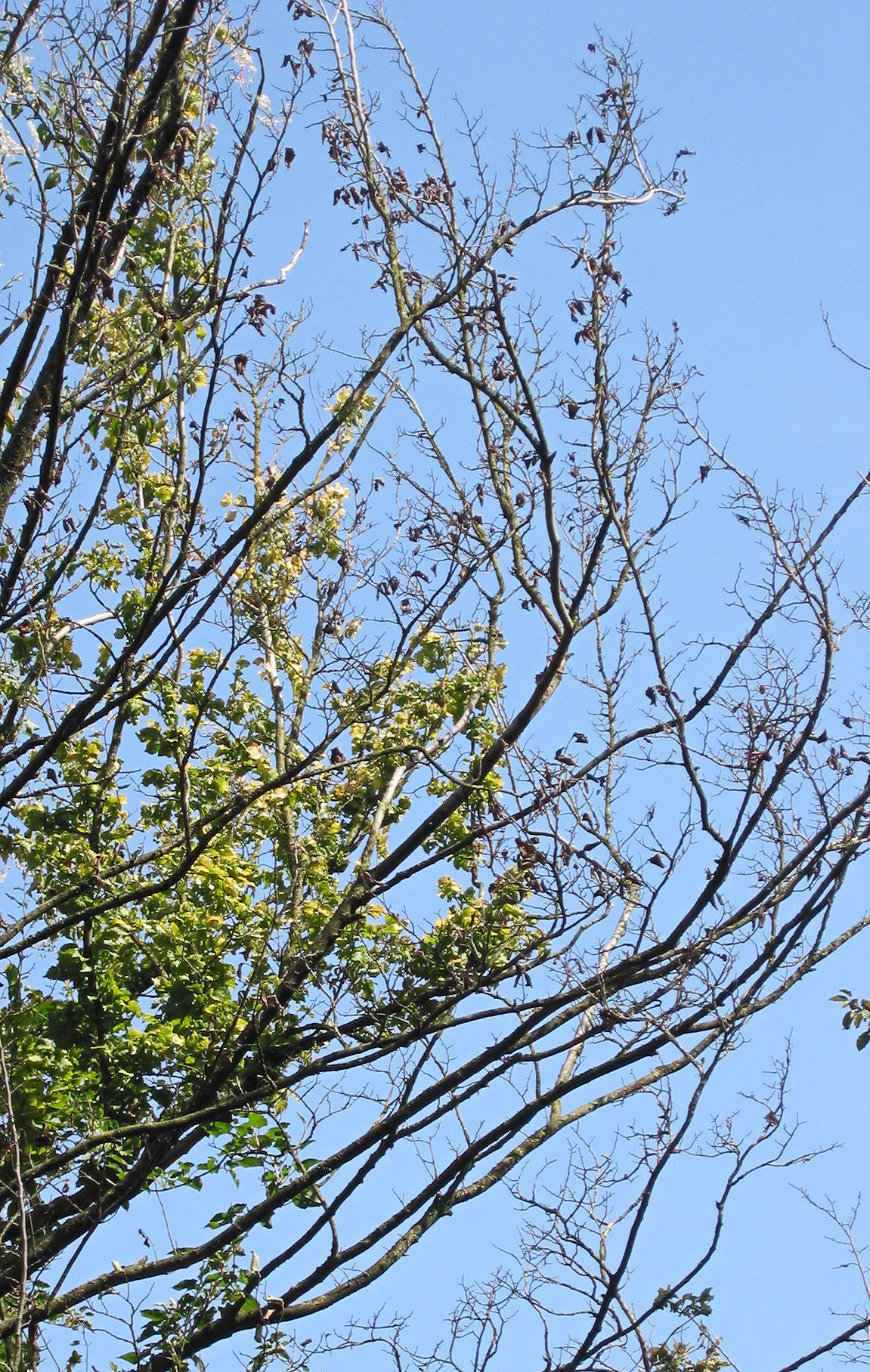
Foliage yellowing and wilting are among the earliest visible symptoms of Ophiostoma infection. Image: Wikimedia Commons (CC)
The pathogen and its carriers
Dutch elm disease is caused by two closely related fungal species: Ophiostoma ulmi, which spread through European elm populations from the 1920s onward, and the more virulent Ophiostoma novo-ulmi, which arrived in Europe from North America and Asia in the 1960s and rapidly displaced its predecessor. The difference in pathogen aggression accounts for the stepwise character of elm decline in Italy: the first wave caused significant but patchwork mortality; the second produced near-total losses in susceptible stands within a few seasons of exposure.
The disease is carried between trees by two elm bark beetles: Scolytus scolytus and Scolytus multistriatus. Both species breed in the cambium layer of weakened or recently dead elm wood, and newly emerged adults carry spores of Ophiostoma on their bodies as they disperse to feed on the bark of healthy trees. Feeding galleries created during this maturation feeding allow spores direct access to the xylem, where the fungus then spreads through the vascular system, triggering the tree's own defensive blocking response and causing the characteristic wilting and branch dieback.
Arrival and spread across the Po Plain
O. novo-ulmi is believed to have entered northern Italy through multiple entry points during the 1970s, likely through infected timber consignments and the movement of elm logs for ornamental and agricultural use. The Po Valley provided near-ideal conditions for rapid spread: a dense network of elm-lined rural roads and irrigation channel banks, high ambient populations of the Scolytus beetles due to centuries of elm dominance, and a relatively mild, humid lowland climate that extended the beetle flight season.
Regional forestry surveys from the 1980s and 1990s documented progressive losses in rural avenues across the provinces of Milan, Pavia, Cremona, Vercelli, and Novara. The pattern was not uniform: isolated farmstead elms sometimes survived for years while avenue populations collapsed entirely. The key variable was the density and continuity of elm plantings — connected rows provided an effective dispersal corridor for beetles carrying infectious spores.
In Lombardy's lowland agricultural zones, field surveys from the 1990s recorded elm mortality rates exceeding 60% in monitored avenue sections, with some road corridors showing complete functional loss within a decade.
Impact on the rural and urban landscape
The visual transformation of northern Italian rural roads following disease-related elm removal has been substantial. Avenues that previously provided continuous summer shade over farm tracks and minor roads were cleared in sections as trees became hazardous. Replacement planting, where it occurred, typically used a mix of species rather than elm, producing the fragmented, multi-species corridors visible today along many provincial roads.
In urban contexts — municipal parks, tree-lined streets in smaller cities, and riverbank plantings — the losses were more variable. Some municipalities removed declining elms proactively; others left standing deadwood until hazard management became necessary. The administrative inconsistency meant that some urban elm populations survived the main disease wave through a combination of geographic isolation, local beetle population dynamics, and, in a few documented cases, the presence of naturally resistant individuals within the planting.
Biological basis of susceptibility
The near-universal susceptibility of Ulmus minor to O. novo-ulmi reflects the species' evolutionary history. Field elms in Europe had no prior exposure to the aggressive strain and therefore no accumulated resistance traits. Research conducted at several European institutions during the 1980s and 1990s — including work at the Istituto di Patologia Vegetale in Milan — confirmed that while individual specimens occasionally showed delayed disease progression, none of the commercially available U. minor material demonstrated consistent field resistance to the pathogen under natural exposure conditions.
The biology of Ophiostoma means that partial resistance is not equivalent to immunity. Trees that slow the spread of vascular colonisation may survive longer, and some may recover from early infections, but in high-inoculum environments — where beetle pressure is sustained and infectious wood is abundant — even moderately tolerant trees face repeated challenge. This distinction between tolerance and true resistance has shaped the criteria used in subsequent cultivar evaluation programmes.
Current population status
Surviving elm populations in northern Italy are not uniform in their health status. Relict individuals — typically found in isolated positions away from former avenue plantings — show varying degrees of condition. Some are visibly symptomatic in a chronic, low-level way; others appear structurally healthy despite ongoing pathogen presence in the surrounding landscape. These survivors have attracted attention from researchers interested in whether natural field resistance can be identified and propagated.
Municipal street plantings of elm, largely discontinued from the 1980s onward, are slowly reappearing in some cities as resistant cultivars become commercially available. Whether these new plantings will maintain their health credentials over decades of field exposure in northern Italian urban conditions remains to be determined by ongoing monitoring.
This article draws on published scientific literature and regional forestry documentation. Population figures are drawn from survey reports available through Italian regional administrations and published research; they are not derived from original field surveys conducted by Elmwick. External references: EPPO — Ophiostoma novo-ulmi.

