The question of which elm cultivars are genuinely useful for street and park planting in northern Italy is not simply a matter of disease resistance scores from controlled greenhouse trials. Urban conditions introduce variables — compacted soils, heat loading from pavement, periodic drought, and root restriction — that alter how a tree performs relative to its trial data. The cultivars that have entered municipal planting lists in Turin, Brescia, and a small number of other northern Italian cities represent a filtered subset of what the European elm breeding programmes have produced, selected partly on resistance data and partly on observed urban adaptability.

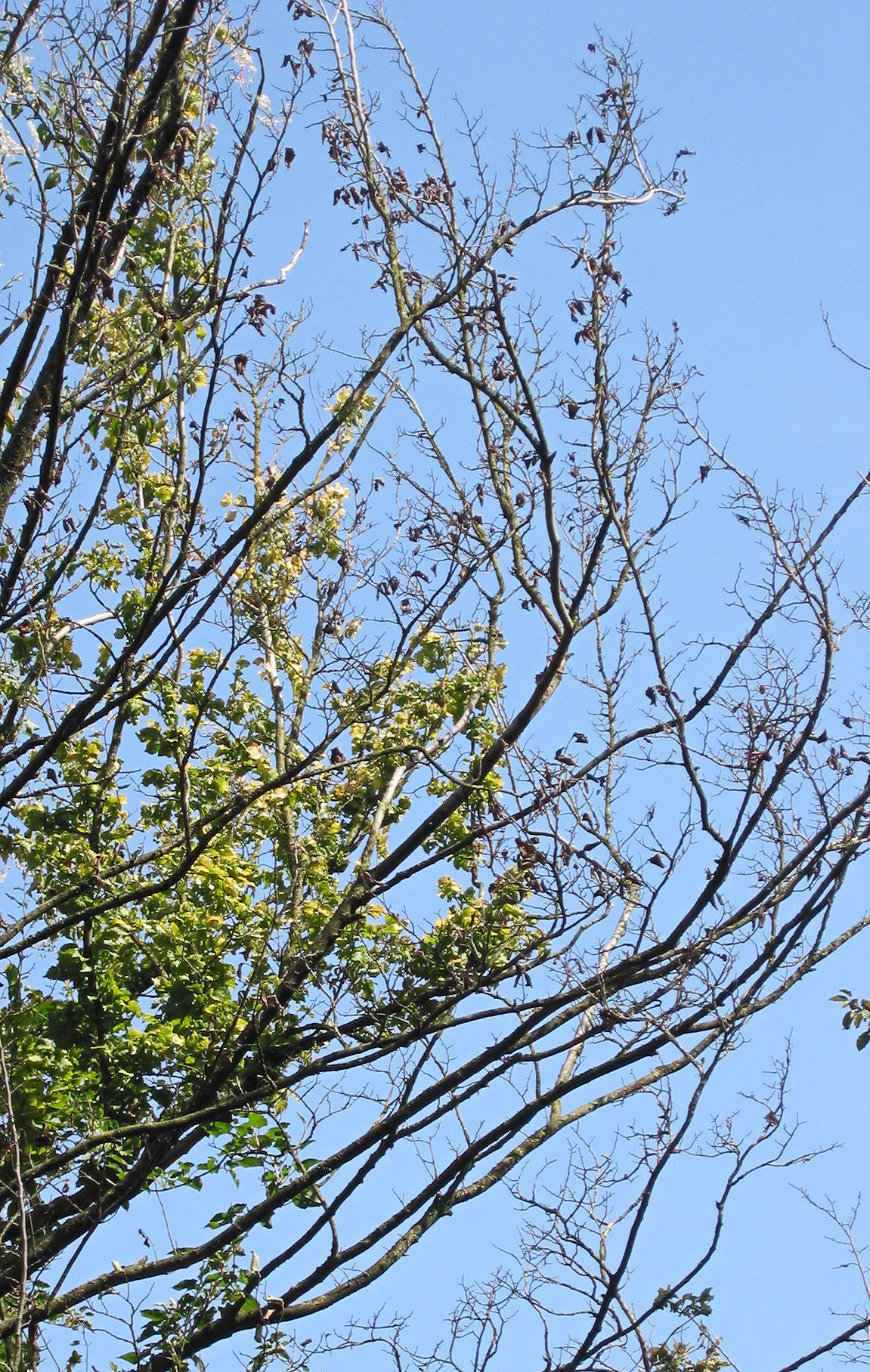
Ulmus minor street tree. Image: Wikimedia Commons (CC)
The European cultivar development context
Systematic work on disease-resistant elms began in the Netherlands in the 1930s, coinciding with the first major epidemic wave. The Dutch programme produced a series of clones, some of which — notably 'Commelin' and 'Groeneveld' — reached commercial distribution before being rendered largely obsolete by the arrival of O. novo-ulmi. A second generation of breeding work, incorporating inter-specific hybridisation using resistant Asian and North American Ulmus species, produced the cultivars now generally considered the basis for contemporary replanting in Europe.
The breeding institutions that contributed most directly to the cultivars now assessed in Italian conditions include the Dutch Research Institute for Nature and Forest (Alterra/Wageningen), the Consortium for the Improvement of Elm Resistance to Dutch Elm Disease (SardEUmed, coordinated under EU research frameworks), and separately developed programmes in Spain and the United Kingdom. Italian research institutions, including groups at the University of Turin and formerly at the Istituto Sperimentale per la Selvicoltura in Arezzo, have contributed evaluation trials rather than primary breeding work.
Cultivars documented in northern Italian field trials
Ulmus 'Rebona'
'Rebona' is a clone developed from a cross involving Ulmus pumila and Ulmus minor material, selected for resistance and for a growth form broadly compatible with street use — upright habit, moderate crown spread, and reasonable tolerance of periodic drought. In Turin street trials monitored from initial planting in 2004 through 2020, 'Rebona' showed no confirmed Ophiostoma infections across the monitored population. Bark beetle feeding activity was recorded but did not result in vascular colonisation in assessed trees. The monitoring data, published in an Italian regional forestry report, noted that beetle pressure in the trial area was moderate; whether results would hold under heavier disease pressure remains an open question.
Ulmus 'New Horizon'
'New Horizon' is a Ulmus japonica × Ulmus pumila hybrid developed initially in North America and later evaluated across several European urban forestry programmes. Its resistance profile derives primarily from the U. pumila parentage, which provides strong vascular-level defence against Ophiostoma colonisation. In Brescia, where a comparative planting was established in the early 2010s alongside native species and other resistant cultivars, 'New Horizon' maintained disease-free status through the 2022 monitoring survey. Reported limitations include a growth form that some municipal arborists describe as less immediately legible as a "traditional" elm — a consideration that carries weight in historic urban contexts where visual continuity with previous tree avenues is a stated objective.
Ulmus 'Lobel'
'Lobel' is a Ulmus × hollandica hybrid from the Wageningen programme, selected for its columnar growth form alongside moderate disease resistance. It has appeared in Italian planting lists primarily in contexts requiring narrow form — alleyways, tree pits with limited overhead clearance, and planting strips between traffic lanes. Resistance data for 'Lobel' is generally considered less robust than for the Asian-species hybrids, and some European monitoring programmes have recorded low-level infections in older specimens, particularly those under stress. Italian municipal forestry assessors have noted this in procurement documentation, with some authorities moving away from 'Lobel' in high-exposure contexts while retaining it for lower-risk plantings.
Selected Ulmus minor clones from Italian provenance surveys
Alongside introduced hybrid cultivars, there has been documented interest in identifying naturally tolerant individuals within surviving Italian Ulmus minor populations. The rationale is primarily one of provenance: locally derived material may carry adaptations to regional soil chemistry, summer heat, and drought patterns that are absent in cultivars developed from northern European or Asian germplasm. A survey conducted in Piedmont in the 2000s identified several individuals showing no disease progression despite confirmed Ophiostoma presence in surrounding stands. These individuals have been the subject of vegetative propagation trials, but none has reached commercial production as of the most recent available documentation.
Evaluation criteria used in Italian municipal contexts
When northern Italian municipalities assess resistant cultivar options, the criteria are not limited to pathogen resistance. Documents from procurement processes in Turin, Milan, and Brescia — where these have been accessible — indicate that evaluators weight the following factors alongside resistance scores:
- Crown form and mature size relative to the urban planting location
- Root system behaviour in sealed-surface environments
- Survival and growth rates in the initial five years after transplanting
- Availability from certified nursery stock in quantities sufficient for planned planting phases
- Visual legibility as an elm — a subjectively applied criterion reflecting public expectation in historically elm-planted corridors
Gaps in the current trial record
A persistent limitation of the available Italian trial data is duration. Most confirmed street plantings of resistant cultivars date from the late 1990s at the earliest; few have been monitored continuously for more than 20 years, and independent published assessments of Italian urban trial outcomes are sparse. The absence of a centralised Italian urban tree monitoring database — a resource that exists in more complete form in some northern European countries — means that municipal experience with these cultivars often remains in grey-literature procurement reports rather than peer-reviewed sources.
Additionally, climate change is altering the variables against which resistance data was originally generated. Higher summer temperatures and more frequent drought episodes in the Po Valley since 2000 create additional stress conditions for street trees that were not fully represented in earlier trial designs. Whether stressed trees carrying resistance cultivar genetics maintain their disease resistance under these conditions at the same rate as unstressed individuals is an area where more field data would be useful.
No cultivar currently available for commercial planting in Italy carries a documented immunity to Dutch elm disease. The terminology used in scientific evaluation — tolerance, resistance, reduced susceptibility — reflects degrees of pathogen defence rather than absolute protection.
Trial data cited in this article derives from published Italian regional forestry reports and peer-reviewed European cultivar evaluation studies. Elmwick has not conducted independent field assessments. For current commercial availability of resistant cultivars in Italy, consult certified nursery suppliers or regional agricultural extension offices. External reference: FAO Forestry.