Decisions about what to plant after a disease-related tree loss are rarely made on horticultural grounds alone. In northern Italian municipalities, replanting following Dutch elm disease has been shaped by budget cycles, landscape heritage assessments, public expectations, procurement constraints, and the availability of nursery stock. The outcomes across Lombardy and Piedmont have been correspondingly uneven — some corridors were replanted quickly with diverse species mixes, others remain largely unplanted decades after elm removal, and a small number have seen deliberate elm reinstatement using resistant cultivar material.

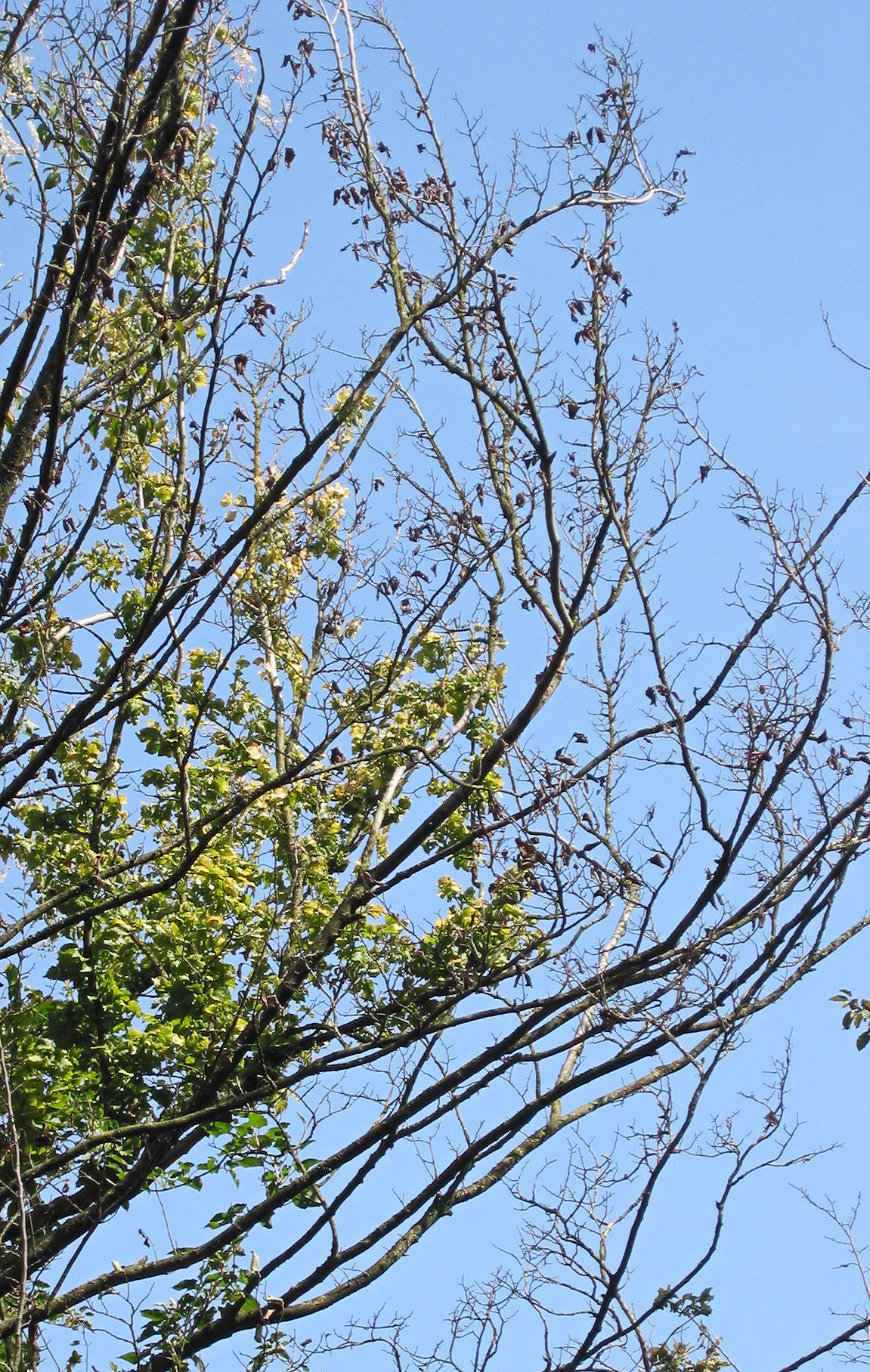
Mature Ulmus minor tree. Image: Wikimedia Commons (CC)
The institutional context of urban tree management
Urban tree management in Italian cities falls primarily under the responsibility of municipal environmental or public works departments, with provincial and regional administrations playing a variable role depending on the jurisdiction. For trees on public roads and in public parks, the municipality holds maintenance and replacement obligations; trees on private land adjacent to public thoroughfares occupy a more complicated legal space, particularly in relation to historic avenue designations under landscape protection legislation.
The practical consequence of this structure is that replanting decisions are made locally, with limited standardisation across the region. A municipal forestry officer in Cremona and their counterpart in Novara may reach different conclusions about species selection, planting density, and monitoring obligations even when addressing broadly similar situations — a road corridor that previously carried a continuous elm avenue and now requires replanting after disease removal.
Lombardy: policy approaches and documented outcomes
Milan
Milan's approach to urban tree replacement has evolved considerably since the major elm losses of the 1980s and 1990s. The city's current urban forestry plan — Forestami, which targets significant canopy expansion across the metropolitan area — does not treat elm reinstatement as a primary objective, but resistant elm cultivars appear on the approved species list and have been used in selected park planting contexts. The 2023 municipal tender for Via Ripamonti tree replacement included 'New Horizon' among the specified options, alongside linden (Tilia) and hornbeam (Carpinus betulus).
The rationale in Milan's planning documentation for including resistant elms alongside alternative species is stated in terms of resilience and diversity: single-species corridors, regardless of the species' resistance profile, are considered a structural risk given the range of potential future threats to urban trees. This position reflects a broader shift in European urban forestry thinking but also acknowledges the practical difficulty of sourcing large quantities of resistant elm nursery stock at the sizes required for high-visibility urban plantings.
Brescia
Brescia's municipal tree replacement activity following elm disease losses has been documented in several regional reports. The city established comparative planting plots in Parco Tarello and along sections of the Naviglio Grande canal bank in the early 2010s, testing resistant cultivars alongside native species and recording survival and condition data on an annual basis. As of the most recently available monitoring report (2022), the resistant cultivar plots showed consistently higher survival rates than the native species control plots in the same locations, though the difference was most pronounced in the first five years after planting rather than in subsequent periods.
Smaller Lombard municipalities
In smaller municipalities — particularly those in the agricultural lowland provinces of Pavia, Lodi, and Mantova — replanting after elm loss has been less systematically documented. Available evidence from regional surveys suggests a predominant pattern of species substitution rather than elm reinstatement: lime and plane tree are the most commonly planted replacements in rural avenue contexts, chosen for their availability, cost, and familiarity to municipal maintenance crews.
Several Lombard provincial road authorities have noted that the cultural expectation of a "boulevard elm" — the specific silhouette and seasonal character of Ulmus minor — remains a reference point in public consultation, even where the practical decision has been to plant alternative species.
Piedmont: species selection and provincial variation
Turin
Turin's urban tree management is among the better-documented in northern Italy, partly because the city has participated in several European urban greening research networks. The municipal green areas department published a tree species assessment in 2018 that explicitly addressed the question of elm reinstatement, concluding that resistant cultivars could be specified for street use in sectors with low to moderate beetle pressure and that their inclusion in the city's approved species list was appropriate.
Subsequent procurement records indicate that 'Rebona' and 'New Horizon' have both been specified in street tree replacement contracts in Turin since 2019, typically as one option within a multi-species planting scheme rather than as sole-species avenue plantings. The city's arborist inspection records, accessed through a regional transparency platform, show no disease events in the monitored resistant cultivar population through 2024.
Piedmont provincial avenues
The Piedmont regional administration has maintained a landscape heritage register that includes several formally designated elm-lined avenues, primarily in the Langhe and Monferrato hill zones where elm planting has historical significance in wine-estate landscape design. For designated avenues, regional landscape protection rules complicate straightforward species substitution: authorities responsible for landscape-designated corridors must generally demonstrate that alternative species are consistent with the historic character of the avenue.
In practice, this has led to documented cases where resistant elm cultivars were favoured for avenue reinstatement precisely because they maintain species identity — they are legally and visually elm — even if their genetic composition differs substantially from the native Ulmus minor material they replace. The regional administration's guidance document on avenue tree replacement, issued in 2020, explicitly recognised this distinction and listed three resistant elm cultivars as acceptable for use in heritage-designated avenue replanting.
Monitoring and long-term programme continuity
A consistent gap across documented replanting programs in both regions is the persistence of monitoring beyond the initial establishment period. Municipal tree planting contracts in Italy typically include a maintenance and monitoring obligation of three to five years from planting; beyond this period, monitoring depends on routine arborist inspection cycles rather than programme-specific protocols. The practical consequence is that independent assessments of how resistant cultivar plantings from the late 1990s and early 2000s are performing now — when trees have reached a size at which disease events would be more informative — are limited.
The urban forestry community in northern Italy has identified this as a gap, and several proposals for regional tree health monitoring networks have been circulated through academic and professional channels. As of 2026, no funded programme providing systematic, cross-municipal monitoring of resistant elm plantings is operational in Lombardy or Piedmont.
Information on municipal programs draws on publicly accessible planning documents, regional forestry reports, and published academic assessments of Italian urban tree management. Elmwick has not independently verified individual municipal planting records. For current program status, contact the relevant municipal or provincial environment departments. External reference: Regione Lombardia — Foreste e biodiversità.